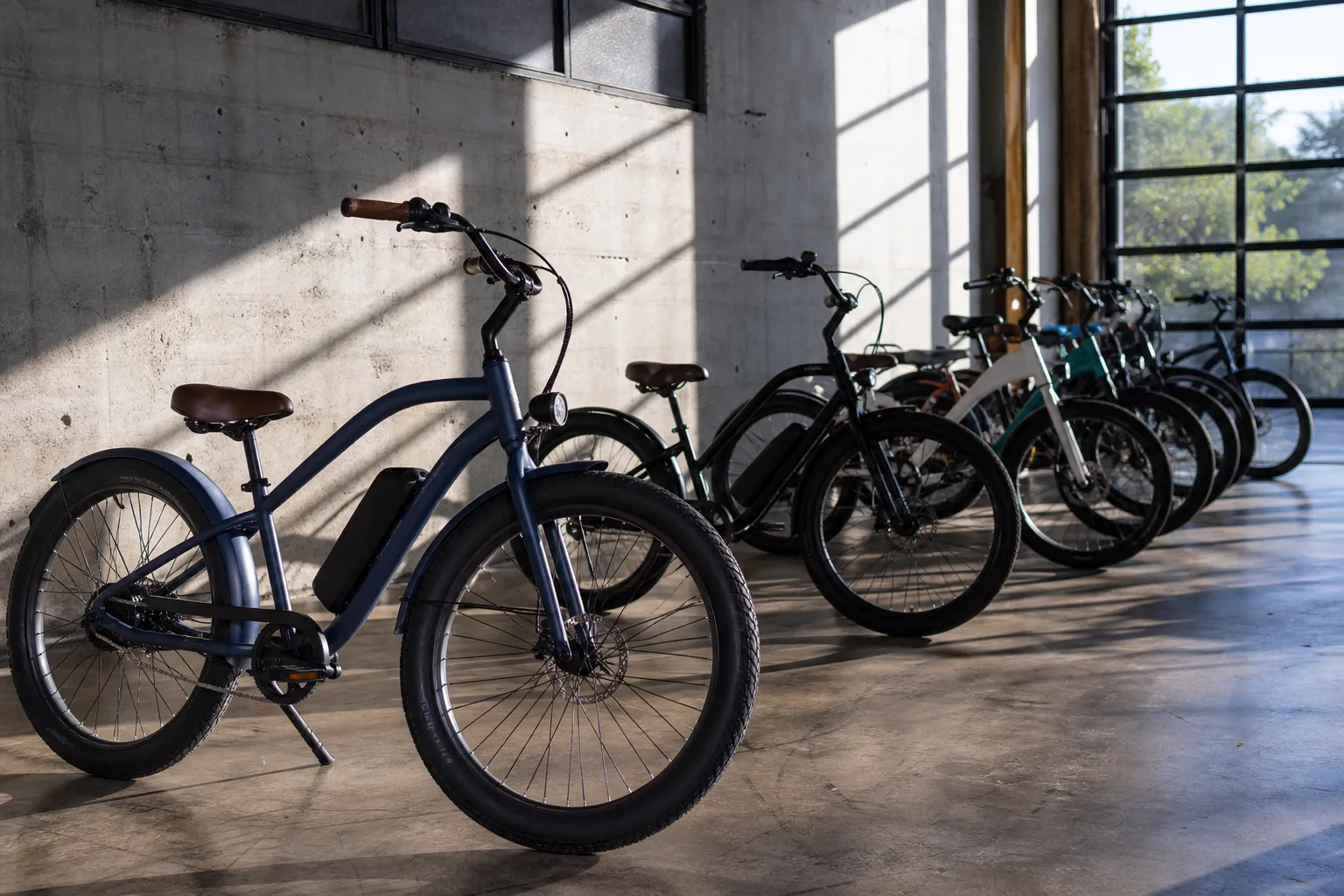
Every upright cruiser sold with a motor carries a range figure somewhere on the listing, and that figure is almost always produced under conditions no buyer will reproduce: a light rider, the lowest assist setting, flat pavement, no wind, fully inflated tires, and a new pack. None of that is dishonest so much as it is unrepresentative. The number a careful reader wants is not on the marketing banner at all. It is in the specification table, expressed in watt-hours, and it is the only battery figure that can be compared honestly across two bikes from two different companies.
Watt-hours, and why volts and amp-hours alone tell you nothing
A pack described as 48 volts and 14 amp-hours holds 672 watt-hours. A 36-volt, 17.5-amp-hour pack holds 630. Voltage on its own describes the electrical architecture, not the size of the tank, and amp-hours on their own are meaningless without the voltage they sit at, which is why two listings can look comparable and differ by a fifth in stored energy. Multiply the two figures and the comparison becomes arithmetic rather than judgment. If a seller publishes only one of the two numbers, that omission is itself information worth acting on.
Consumption is the other half. Riders and reviewers reporting real figures for upright, moderately heavy cruisers generally land somewhere in the low teens of watt-hours per mile on flat pavement at modest assist, rising steeply from there. Divide the pack size by a realistic consumption figure and the result will usually sit well below the advertised range, and much closer to what the driveway odometer eventually shows.
What the road takes back
Four variables account for most of the gap, and they compound rather than add. Rider and cargo weight matter most on the accelerations, since every stop sign is energy spent getting back up to speed, and a cruiser carrying a rider, a lock, and a bag of groceries is a meaningfully different machine from the one in the test. Headwind is the quiet one: air resistance climbs with the square of speed, so a fifteen-mile-per-hour breeze against a fifteen-mile-per-hour cruise roughly doubles the aerodynamic work. Tire pressure is the cheapest fix available, and balloon cruiser tires lose pressure faster than they look like they should. Assist level does the rest.
Throttle use, common on Class 2 cruisers, is the largest single discretionary drain, because a throttle applies motor power without any pedal contribution at all. A rider who pedals steadily at the second of five assist levels and a rider who thumbs the throttle from every light are drawing on the same pack at very different rates. Neither is wrong. But only one of them will see the number on the box.
Cycles, calendar age, and where the pack is stored
Lithium-ion packs on consumer bikes are typically rated for several hundred full charge cycles before capacity settles noticeably below new, and manufacturers usually define the end of useful life as a percentage of original capacity rather than a failure. Partial charges count proportionally, so topping up from seventy percent is not a whole cycle. Calendar age matters independently of use, and heat accelerates it. A pack left on a concrete garage floor through a Phoenix summer, or in an unheated shed through a Minnesota winter, ages faster than one kept indoors at room temperature, which is why most manuals specify a storage window and a partial state of charge, commonly around half, for anything stored longer than a few weeks. The Consumer Product Safety Commission oversees safety standards for these batteries and their chargers, and buying a pack and charger certified to a recognized standard is the single clearest thing a buyer can check.
The replacement pack, three or four years in
This is the ownership cost most first-time buyers do not price. A replacement pack from the original manufacturer generally runs a substantial fraction of what the whole bike cost, and the practical question is not the price but the availability: proprietary frame-integrated packs from a company that has since revised its frame can become hard to source, while a common rear-rack or downtube pack in a widely used form factor stays available from multiple suppliers. Ask, before buying, what the replacement part number is and whether it is stocked. A shop that answers immediately is telling you something useful.
Read the specification table, do the multiplication, discount the advertised range by a third or more for real conditions, and confirm the pack can be replaced. Four checks, none of them difficult, and together they turn the range question from a guess into an estimate.